Hungary's savoury cooking receives most of the international attention, but the country's pastry tradition is equally remarkable. Budapest's confectionery culture, rooted in the Austro-Hungarian era, produced some of Europe's most sophisticated cakes and pastries. Meanwhile, the countryside preserved older traditions of rolled strudels and chimney cakes that date back centuries.
This guide covers the most important Hungarian desserts: where they came from, what makes them distinctive, and how they are prepared.
Dobos Torte: Budapest's Most Famous Cake
The Dobos torte was created in 1885 by Jozsef C. Dobos, a Hungarian confectioner and food entrepreneur. It consists of five thin layers of sponge cake, each spread with chocolate buttercream, topped with a hard caramel glaze. The cake was revolutionary for its time because the caramel topping acted as a preservative, allowing the torte to be shipped and stored much longer than other cream cakes of the period.
Dobos first presented the cake at the National General Exhibition in Budapest, where it caused a sensation. He kept the recipe secret for nearly three decades before eventually donating it to the Budapest Confectioners' and Gingerbread Makers' Guild shortly before his death. The recipe was then made public, and the torte became a standard offering in Hungarian patisseries.
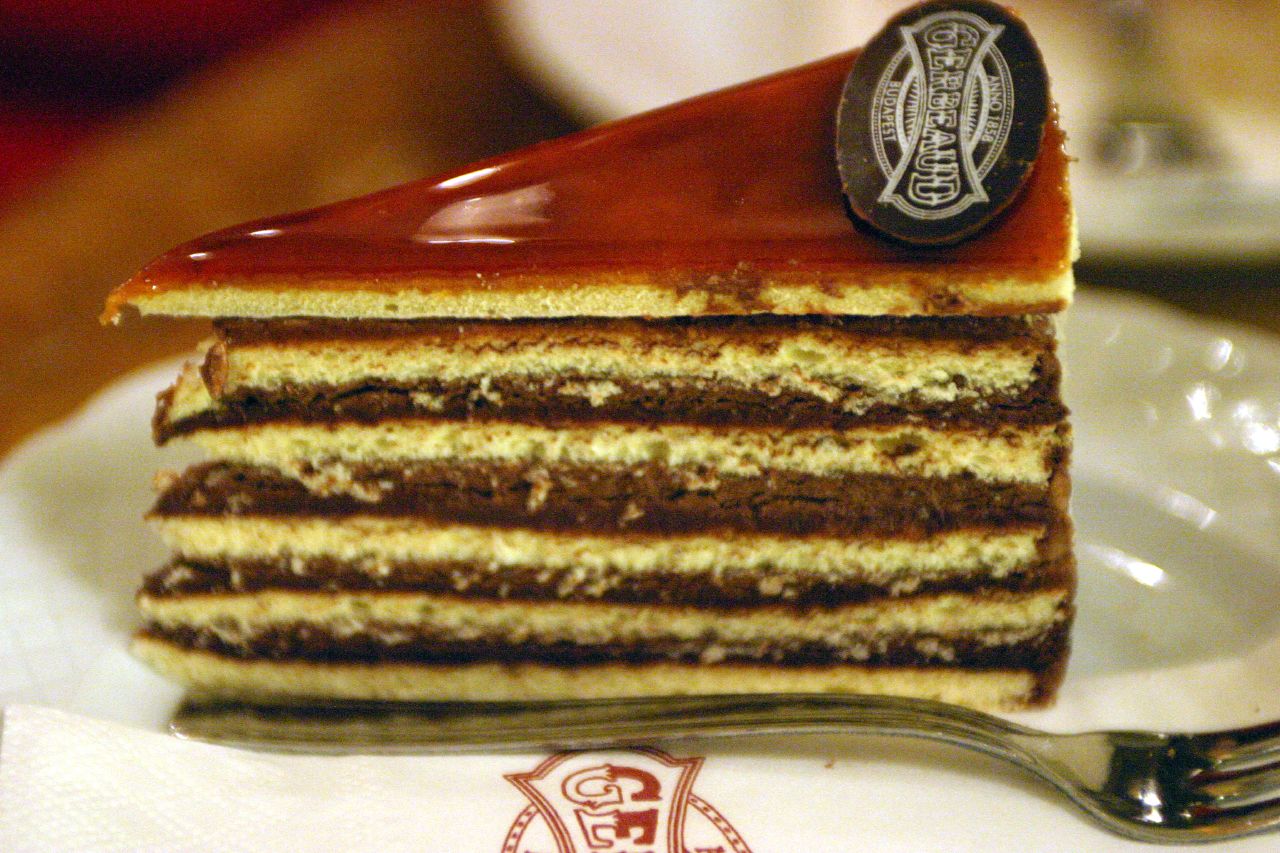
Image: Wikimedia Commons. Dobos torte at Gerbeaud Confectionery, one of Budapest's oldest and most celebrated pastry houses.
Making a Dobos torte at home is a project. The sponge layers must be thin and even, which requires careful baking and, in some traditional recipes, spreading the batter onto the back of inverted cake tins. The buttercream should be rich but not heavy. The caramel topping requires working quickly before it hardens, cutting portions while the caramel is still pliable.
The result, when done well, is a cake of remarkable elegance: layers of tender sponge and smooth chocolate cream, crowned by a shatter of golden caramel.
Kurtoskalacs: The Chimney Cake
If the Dobos torte represents Budapest's sophisticated confectionery tradition, kurtoskalacs represents something older and more rustic. This cylindrical pastry, baked on a wooden spit over hot coals, originated in the Hungarian-speaking communities of Transylvania (now part of Romania) and has been documented since at least the 17th century.
The name translates roughly as "stovepipe cake," which accurately describes its shape. A strip of sweet, enriched yeast dough is wrapped around a wooden cylinder, coated with sugar, and slowly rotated over heat until the outside caramelises into a crisp shell while the interior remains soft and slightly hollow.

Image: Wikimedia Commons. Traditional kurtoskalacs baking on wooden spits.
Traditional toppings include granulated sugar, ground walnuts, and cinnamon. Modern versions in Budapest's tourist areas offer variations with chocolate, coconut, and other coatings, though purists regard these with scepticism.
The best kurtoskalacs is eaten warm, pulled apart in strips from the outside. The contrast between the crunchy, caramelised exterior and the soft, yeasty interior is what makes the pastry satisfying. Once it cools completely, it loses much of its appeal.
Retes: Hungarian Strudel
Strudel in Hungary predates the better-known Viennese version. The technique of stretching dough paper-thin over a cloth-covered table is one of the most impressive skills in Central European baking, and Hungarian cooks have practiced it for centuries.
The key to retes dough is gluten development. The dough is made from strong flour, water, oil, and a small amount of vinegar (which helps with elasticity). After kneading, it must rest for at least 30 minutes to allow the gluten to relax. The stretching is then done by hand, working from the centre outward over a floured tablecloth until the dough is translucent enough to read newspaper print through it.
Classic Fillings
The most traditional Hungarian strudel fillings include:
- Almasi retes (apple strudel): Grated apples with sugar, cinnamon, raisins, and toasted breadcrumbs. The breadcrumbs absorb moisture from the apples and prevent the dough from becoming soggy.
- Turos retes (curd cheese strudel): Sweetened quark or cottage cheese with raisins, lemon zest, and sometimes semolina. This is arguably more popular in Hungary than the apple version.
- Meggyes retes (sour cherry strudel): Fresh sour cherries with sugar. The tartness of the fruit against the buttery pastry is exceptional during cherry season in June and July.
- Makos retes (poppy seed strudel): Ground poppy seeds cooked with sugar and milk into a thick paste. This filling is particularly associated with Christmas.
Budapest's Confectionery Culture
Budapest's cukraszdak (confectioneries) are institutions in their own right. Unlike cafes, which focus on coffee, these establishments are primarily about pastry, and the best of them maintain traditions that stretch back to the 19th century.
Gerbeaud, on Vorosmarty ter, has been operating since 1858 and remains the most famous. Its interior retains the grandeur of the Austro-Hungarian period, and its pastry selection is extensive. The Gerbeaud szelet, a layered pastry with walnut and apricot jam, is the house specialty.
Ruszwurm, in the Castle District, is even older, dating to 1827. It is a much smaller establishment, with only a handful of marble-topped tables, but the quality is exceptional. The kreamess (cream slices) and the dobosse are particularly worth trying.
Central Kavehaz on Karolyi Mihaly utca is another historic establishment, reopened in 2000 after decades of closure. It combines the cafe and confectionery traditions and serves both coffee and pastries in an opulent interior.
Other Desserts Worth Knowing
Somloi Galuska
A trifle-like dessert made from three colours of sponge cake (plain, chocolate, and walnut), soaked in rum syrup, layered with chocolate sauce and vanilla custard, and finished with whipped cream. It was created in the 1950s at the Gundel restaurant in Budapest and has since become one of the most popular Hungarian desserts.
Turos Csusza
Not a dessert in the traditional sense, but often served as one. Broad noodles mixed with quark cheese, sour cream, and crispy bacon. The combination of savoury and rich is distinctly Hungarian. Some versions include sugar, making it a true dessert; others remain firmly savoury.
Palacsinta
Hungarian crepes, thinner than French crepes and typically served rolled rather than folded. The most famous version is Gundel palacsinta, filled with a walnut and rum mixture and served with chocolate sauce. Simple versions filled with apricot jam or sweetened quark are everyday fare.
Further Reading
The Wikipedia article on Dobos torte provides detailed historical context, and the kurtoskalacs article covers the chimney cake's origins in Transylvania. For an overview of Central European baking traditions, the strudel article traces the pastry's history across the former Habsburg lands.